How to Create a Website for Your Business in Nigeria (2026 Guide)
How to create a business website in Nigeria: the types of website, domain choices, developer versus no-code options, typical costs, trust and SEO basics, and when an ecommerce store like Webift is the right fit.
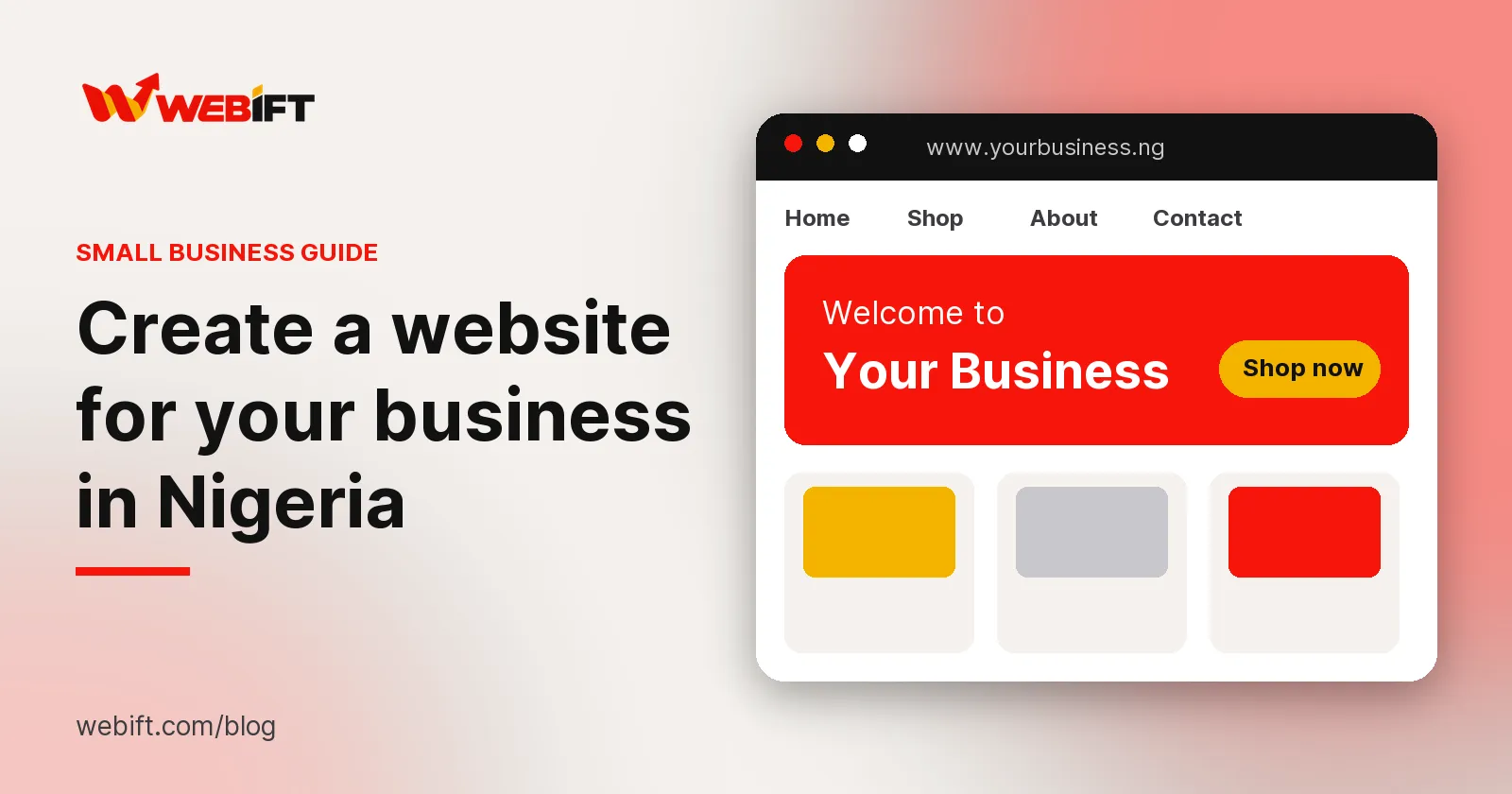
The short answer: to create a website for your business in Nigeria, decide what the site must do (inform, take bookings or sell products), choose and register a web address, pick how you will build it (a developer, a no-code builder or an ecommerce platform), add clear content and contact details, make sure it works well on phones and set up basic search visibility and trust signals. If your main goal is to let customers browse and buy products, an ecommerce platform such as Webift gets you there faster than a general website.
Last updated 12 October 2026. Prices and features mentioned were checked on that date and may change.
If you want a website where customers can browse and buy your products, you can create your Webift store and see how it works.
Why does a business need an online presence?
Customers search before they buy, even when they end up buying in person. A business that appears in search results, has a phone number that works and shows real photos earns trust before the first message is sent. A website also gives you a place you control: you are not at the mercy of an app's algorithm, and your information stays available when social media pages are quiet or restricted.
For a Nigerian business, a website can help customers confirm that you exist, see where you operate, find your prices or catalogue and contact you quickly.
Types of business websites
- Informational (brochure) website: a few pages that explain who you are, what you do, where you are and how to contact you
- Portfolio website: shows past work, for designers, photographers, builders and consultants
- Booking or service website: lets customers request a quote or schedule a service
- Ecommerce website (online store): lists products, takes orders, collects payment and manages delivery
- Blog or content website: shares articles to attract search traffic
Many businesses combine two or three of these.
Informational website or ecommerce store?
The difference is what a visitor can do. On an informational site, a visitor reads and then calls or messages you. On an ecommerce store, a visitor chooses products, pays and arranges delivery on the site.
Ask yourself: do I need customers to buy from me without speaking to me first? If yes, you need an ecommerce store. If you mainly sell services that require a conversation, a simple informational site may be enough.
Choose a domain or website address
Your domain is your web address, such as yourbusiness.com or yourbusiness.ng. Good domains are short, easy to spell on a phone and match your business name. Common options include .com, .com.ng and .ng. Domains are registered through accredited registrars and renewed regularly, so compare registrar prices and renewal terms rather than only the first-year price.
If you start with an ecommerce platform, you may get a platform address first. Webift stores, for example, have a Webift web address such as webift.com/yourstore, and a subdomain such as yourstore.webift.com can be chosen in the store publishing settings. Check the Domains section of your dashboard for current custom-domain options.
Website development options
Hire a developer or agency
You get a custom site built to your needs. This suits complex requirements, but it costs more and you depend on the developer for changes. Agree the scope, timeline, ownership of the files and domain, and who handles hosting and updates, in writing.
Use a freelancer with WordPress
WordPress is a popular content management system. A developer can build a flexible site, and you can add ecommerce with a plugin. You pay for hosting, a domain, a theme and extensions, and the site needs regular updates and backups.
Use a no-code website builder
No-code builders such as Wix let you build pages with a drag-and-drop editor. Wix lists plans in US dollars on its plans page (Core $29.77 and Business $39.77 per month on annual billing when we checked), and says price and currency vary by location. Check which payment methods work for Nigerian merchants if you plan to sell.
Use an ecommerce platform
If your goal is selling products, a platform built for ecommerce gives you a catalogue, cart, checkout, orders and inventory out of the box. Webift is one example, and we compare others in our guide to the best ecommerce platforms in Nigeria.
Typical website cost components
Prices vary widely, so use this as a checklist rather than a price list:
- Domain name: an annual fee
- Hosting: included on hosted builders and platforms, separate on WordPress
- Design or theme: free templates up to paid themes or custom design
- Development time: the largest cost when you hire a developer
- Content: photography, copywriting and logo
- Ecommerce and payment fees: payment gateway fees on each sale
- Maintenance: updates, backups and security
- Marketing: ads or SEO work, if you choose
Always ask for the total first-year and second-year cost, because renewals and add-ons can change the picture.
Create an ecommerce storefront
If you decide to sell online, the practical steps are the same on most platforms: create an account, add products with good photos and prices, set payments and delivery, and publish. Our step-by-step guide to creating an online store in Nigeria shows the process on screen with Webift.
Branding your website
- Use your logo and two or three consistent colours
- Choose readable fonts and keep text short
- Use real photos of your products, team and premises rather than stock images
- Write in the voice your customers use
- Keep the same name, logo and tone on your website, WhatsApp and Instagram
Add products and useful business information
Every business website should answer the questions customers ask first:
- Who are you and what do you offer?
- Where are you, and where do you deliver or serve?
- How do I contact you? Add a phone number, WhatsApp number and email
- What are your prices, or how do I get a quote?
- What are your opening hours?
- What is your delivery and return policy?
- Can I see proof, such as photos, reviews with permission or past work?
For products, include a clear name, price, photos, description, and stock or availability.
Payment integration
If you sell on your website, you need a way to collect payment. Common options in Nigeria are Paystack and Flutterwave for cards, bank transfer and USSD, manual bank transfer, and cash on delivery for physical goods. Each provider has its own fees and terms. Paystack's published local fee was 1.5% plus ₦100 capped at ₦2,000, and Flutterwave's was 2% (checked 12 October 2026). Our guide to accepting online payments in Nigeria explains each option.
Mobile usability
Many Nigerian customers browse on phones, often on limited data. Make sure your site:
- Loads quickly, with compressed images
- Has large, tappable buttons
- Uses readable text without zooming
- Puts your phone and WhatsApp contact near the top
- Has a simple checkout with few steps
Test it on at least two real phones before launch.
Basic search engine optimisation (SEO)
SEO helps people find you on Google. Start with the basics:
- Give each page a clear title that includes what you do and where, such as "Ankara dresses in Lagos"
- Write a short meta description for each important page
- Use headings, short paragraphs and descriptive image names
- Add your business name, address and phone number consistently
- Create a free Google Business Profile if you have a location customers can visit
- Ask happy customers for reviews, with their permission
- Publish helpful content that answers real customer questions
- Submit your site to Google Search Console to see how it performs
SEO takes time, and no one can guarantee a particular ranking.
Security and trust
- Use a site that loads over HTTPS (the padlock in the address bar)
- Use strong, unique passwords and two-factor sign-in on your hosting, domain and email accounts
- Keep software updated if you use WordPress
- Show a real address, phone number and email
- Publish clear delivery, refund and privacy information
- Use payment providers that handle card details securely, so you never store card numbers yourself
When is Webift the right choice?
Webift is an ecommerce-first platform. It is built for businesses that want customers to browse products, pay and receive orders. It is a good fit if:
- You sell physical products, digital downloads or services
- You want Paystack, Flutterwave, bank transfer or cash on delivery at checkout
- You want delivery set up by Nigerian state or city
- You do not want to manage hosting or code
Webift has a free plan with no subscription price and a Standard plan from ₦5,000 per month (checked 12 October 2026; prices may change). Payment-provider fees are separate.
Important: Webift is not a general-purpose website builder. It does not offer free-form page design for brochure sites, portfolios or blogs, so it is not the right choice if you only need a few informational pages.
Want a website where customers can browse and buy your products? Create your Webift store.
When is a custom website or another platform better?
- You need a brochure or portfolio site with custom pages: use a website builder or WordPress
- You need unique functionality, such as complex bookings or integrations: hire a developer
- You sell mainly to customers abroad or need advanced apps: consider platforms such as Shopify
- You need a point-of-sale system for a physical shop: compare tools like Bumpa
Many businesses use a simple informational website for their brand and a separate store for sales. You can compare options in our guide to Shopify alternatives in Nigeria.
Frequently asked questions
How much does it cost to create a business website in Nigeria?
It depends on the route. A no-code builder or ecommerce platform has a monthly or annual plan, while a developer-built site has a design and development cost. Add a domain, any extras and payment fees. Always ask for the full first-year cost.
Do I need a domain name?
It helps. A domain gives you a professional address. Some platforms give you a platform address to start with.
Can I build a website without coding?
Yes. Website builders and ecommerce platforms let you build without code.
Is a Facebook or Instagram page enough?
Social pages are useful for reaching customers, but a website gives you a place you control, with your own information, payment options and search visibility.
Can Webift make a general business website?
No. Webift is for online stores. If you need a brochure or portfolio website, use a website builder or WordPress.
How do I get my website on Google?
Publish useful pages, use clear titles and descriptions, create a Google Business Profile if relevant and submit your site to Google Search Console. Results take time.
Final thoughts
Start with the job your website must do. If that job is selling, choose a platform built for it. If it is explaining who you are, a simple site is enough. When you are ready to sell online, create your Webift store.